
The pitch, and the part of it that survives contact
The usual pitch to a coastal business runs like this: put a bitcoin sign in the window, and tech-minded tourists with money will find you, spend, tell others, and come back.
Most of that is marketing. The part that holds up is smaller and more useful.
A bitcoin payment over Lightning settles in seconds, costs the merchant a fraction of a card fee, cannot be reversed a month later by a stranger's bank, needs no terminal beyond a phone, and works for a foreign customer whose card issuer has decided your country is suspicious. For a kiosk on a beach in a country with capital controls, an unstable currency or thin card infrastructure, those are not abstractions. They are the four things that actually go wrong on a Saturday in January.
What it is not is a source of customers. That claim is testable, and it has been tested.
What the measurement showed
El Salvador ran the largest merchant-acceptance experiment there has been, and it ran it under compulsion, which should have been the easy case.
The best measurement of it, a nationally representative survey published by the NBER, found that at the peak 20 percent of firms accepted bitcoin, 4.9 percent of their sales were paid in it, and 1.2 percent of remittances arrived through a crypto wallet. Accepting is not the same as being paid. A merchant who installs the rail and waits for volume that never arrives has learned something expensive about the difference.
Then the legal case went away entirely. In January 2025 the Legislative Assembly amended the Bitcoin Law: the obligation on economic agents to accept bitcoin became a permission, the tax channel was repealed, and so was the state trust that had guaranteed instant conversion into dollars. Anything you read that says Salvadoran businesses must take bitcoin is describing a regime that ended.
Every argument for accepting bitcoin is now a commercial argument. There is no other kind left anywhere in the world, and honestly there never was one worth much: the compulsion produced compliance, not circulation.
What a mandate could not do, and what did
The odd thing about El Salvador is that the part which worked was never the law.
El Zonte, the surf town on the coast that became known as Bitcoin Beach, has run a circular economy since 2019, two years before the Bitcoin Law and continuing after the mandate's repeal. Its own description of itself is unusually candid about the mechanism: it is backed by a donation from an early bitcoin holder, it pays local stipends in bitcoin rather than converting the donations, and the coins circulate through utility bills, medical care, food and haircuts over Lightning.
Note what that describes. Somebody put bitcoin in people's hands, in a place small enough that they could spend it locally, at businesses close enough together that spending it was easier than converting it. That is the whole mechanism, and none of the three parts is a law. The same shape appears in Costa Rica's southern Pacific zone, where Bitcoin Jungle covers a cluster of adjacent towns, Uvita, Dominical, Ojochal, Platanillo and Tinamaste, and maintains its own merchant map.
It also names the honest weakness. El Zonte's circulation was seeded by a donor, and it is still raising funds to extend the model. A circular economy that needs an initial subsidy is not a counterexample to the measurement above. It is an explanation of it: without somebody supplying the coins, acceptance and spending never meet.
Density is the variable
Which is why the useful question for a beachfront business is not "should I accept bitcoin" but "how many businesses within walking distance already do".
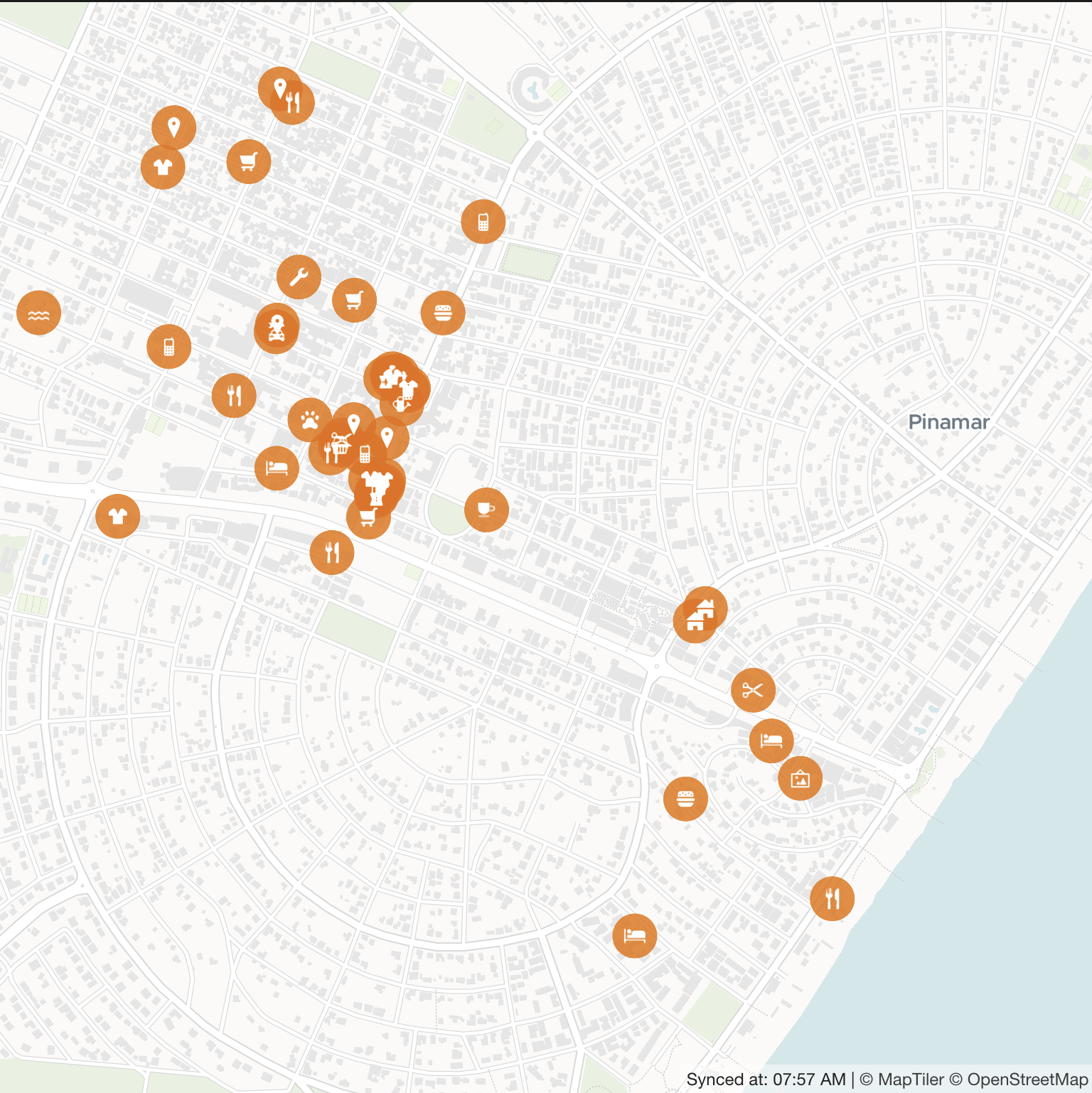
That is Pinamar on the Argentine coast, rendered by BTC Map from OpenStreetMap data. The same coastline is on MappingBitcoin, which is where this site's merchant directory moved and where the rest of this library now sends readers looking for a place to spend. Both read the same OpenStreetMap records, so the pins are the same pins. Every pin is a business somebody has tagged as accepting bitcoin: restaurants, a hotel, a hairdresser, groceries, clothing. The listings are community-maintained and go stale, so treat the map as a lead and not as a guarantee, which is roughly how to read any of these directories.
A single accepting business in a town of two hundred is a novelty, and its customer has to choose to spend rather than hold. Thirty of them in eight blocks is a place where a visitor can arrive with sats and leave without touching an exchange, and where a waiter paid in bitcoin has somewhere to spend it before deciding to sell. The second case is the one that produces repeat volume. The first mostly produces a photograph.
If you are the only one in your town, the honest expectation is a handful of transactions a season and the option value of being early. That may still be worth the ten minutes it takes to set up. It is not worth a business plan.
The tradeoffs, said plainly
Accepting bitcoin moves your risks around rather than removing them.
You take price risk from the moment of the sale. Convert immediately and you have a payment rail, not a hedge, and you are back to depending on whoever does the converting. Keep the bitcoin and you are holding a volatile asset against fixed costs like rent and wages, which is a decision about your balance sheet and not about payments. In a country with a depreciating currency that trade may look obvious; it is still a trade, and it can go against you for years.
Irreversibility protects you from chargeback fraud and removes your recourse in the same stroke. A mistaken payment to the wrong address is gone, and a refund is a new payment you choose to make.
Then there is custody. Payments received into a wallet you control are yours, with all that implies: nobody can freeze them, and nobody can restore them if you lose the backup or an employee walks off with the phone. If takings accumulate, the setup that was fine for a beach kiosk stops being fine, and the custody question becomes a real one. Tax does not go away either. A sale is a sale in whatever unit it was paid.
Where this leaves you
Take bitcoin because the rail is cheap, fast, hard to reverse and works when cards do not. Take it because a specific customer wants to pay that way and you would rather have their money than not. Take it, above all, if the shops around you take it, because that is the only condition under which any of this compounds.
Do not take it because a headline said a country made it mandatory. That regime lasted three and a half years, and the thing that outlived it was a surf town with a donor, a Lightning wallet and enough neighbours to spend at.
Correction, 20 August 2026. This post originally named a specific Pinamar hotel as accepting bitcoin and described Jericoacoara in Brazil as "Bitcoin Beach Brazil" with merchant integration. Neither claim could be verified against a source and both have been removed. The post also read as though El Salvador's 2021 acceptance mandate were still in force; it was repealed in January 2025 and the post has been rewritten accordingly.